A year on, here are the statistics on the Linux distributions running on our infrastructure. Don't expect surprises, but there are some trends.
For the third time (2015, 2016), we're giving you a look at the distributions our members run here. We currently have 1201 members running 1637 individual virtual servers.
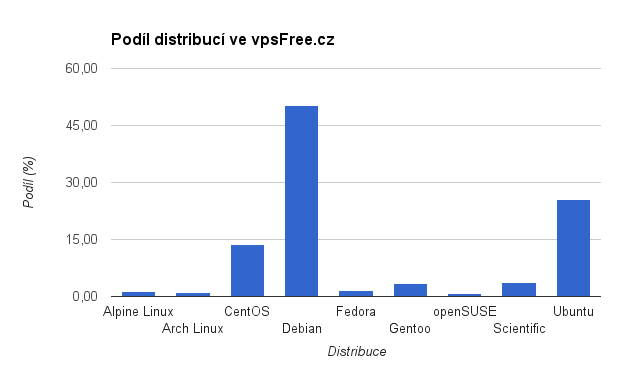
We've added 525 new VPSes over the year, so naturally all distributions have grown in absolute numbers. The only exception is Scientific Linux, which continues to decline and is probably being gradually replaced on VPSes by the more widespread CentOS. Here's the resulting table:
| Distribution | Share | Count | Absolute annual change |
|---|---|---|---|
| Alpine Linux | 1.45% | 23 | +19 |
| Arch Linux | 1.0% | 16 | +1 |
| CentOS | 13.6% | 216 | +42 |
| Debian | 50.4% | 801 | +118 |
| Fedora | 1.6% | 25 | +13 |
| Gentoo | 3.5% | 55 | +11 |
| OpenSUSE | 0.8% | 13 | +4 |
| Scientific | 3.6% | 57 | -9 |
| Ubuntu | 25.6% | 407 | +83 |
As expected, Debian, Ubuntu and CentOS are growing the most. Together, they've gained a little more ground again and run on almost 90% of the virtual servers we host. Fedora is also doing very well, for example, having doubled its share over the year.
The clear winner in growth this year is Alpine Linux, which increased its share almost sixfold. It has overtaken Arch and openSUSE, for example, and Fedora is only two VPSes ahead. By the way, we host one of Alpine's important mirrors.
At the very bottom are distributions we don't even include in the statistics. Void Linux runs on just one server, nobody uses NixOS, and the once-popular Slackware has only two fans among our members. Devuan has four installations so far, but its stable release is very recent; we'll see how it does after a year.
CentOS je prostě fajn. :-)
...si myslí v RedHat